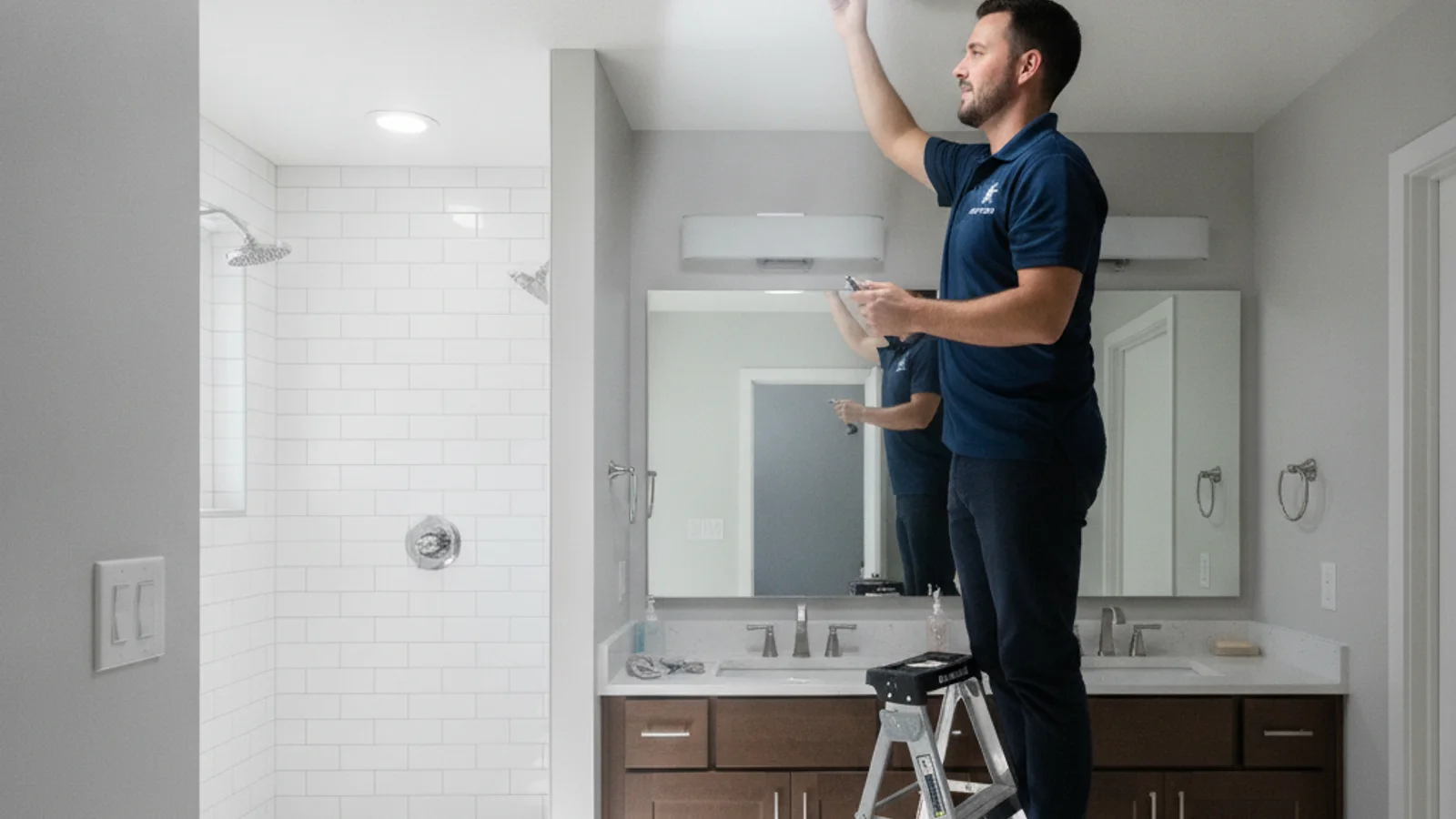
An interior bathroom with no exterior wall is one of the single best use cases for a solar tube. A skylight isn’t structurally an option without an exterior wall or roof plane directly above the room, and wiring in a window isn’t either since there’s no outside wall to put one in. A solar tube, running through the attic to a small roof dome, sidesteps both problems by needing only a roof penetration and a ceiling cutout, neither of which depends on the room having an exterior wall at all.
Why interior bathrooms exist in the first place
A lot of Austin’s housing stock, especially additions and remodeled floor plans, ended up with a bathroom boxed into the center of the house rather than along an exterior wall. That’s often a layout decision made for plumbing efficiency or space planning, keeping fixtures close to shared plumbing runs, and it leaves the room permanently dependent on an overhead light with no daylight option at all, until a solar tube changes that. If you’ve lived in a house with this layout, you already know the specific feeling of a bathroom that’s fine functionally but always slightly dim and cave-like no matter what bulb you put in the fixture.
Moisture and the tube
A properly installed solar tube handles normal bathroom humidity without issue. The dome and tube assembly are sealed the same way any roof penetration is sealed, and daily humidity from a shower doesn’t reach the tube itself in any meaningful way, since the tube is a sealed system running through the attic space above the ceiling, not open to the room’s air directly. Where condensation risk actually comes from is a different mechanism entirely, usually warm indoor air meeting a cooler surface inside the tube on cold mornings, which we cover in more detail in a separate post on skylight and tube condensation. That’s worth understanding, because a homeowner who sees any moisture near a tube fixture in a bathroom might assume the humidity from the shower caused it, when the actual cause is usually a temperature differential unrelated to the room’s typical use.
Ventilation still matters
A solar tube adds light. It does not add airflow, and it isn’t a substitute for a working exhaust fan. That distinction matters because a badly vented bathroom fan, one that dumps moist air into the attic instead of outside through a proper duct, creates its own separate attic moisture problem that has nothing to do with the tube at all. We cover that specific issue, venting into the attic, in a dedicated post, because it’s a surprisingly common problem in older homes where the fan duct was never properly run all the way out. Adding a solar tube to a bathroom is a good moment to also confirm the exhaust fan is actually ducted outside rather than dumping into the attic space right next to where the tube runs.
Sizing for a small room
A standard bathroom, even a small interior one, usually only needs a single small-diameter tube to make a real difference. Bathrooms are typically compact enough that a 10-inch tube provides more than enough daylight, without needing the larger diameter or multi-tube setup a bigger room might call for. This keeps both the cost and the install footprint modest compared to a larger room project.
Install disruption specific to a bathroom
The attic run for a bathroom solar tube often has to work around existing plumbing vents and fixtures already up there, which a good installer plans for before cutting anything. It doesn’t usually add much time to the job, but it’s worth having the attic checked ahead of the install date rather than assuming a clear, straight run, particularly in an older home where plumbing vent placement wasn’t always planned with future daylighting projects in mind.
What to check before assuming a tube won’t fit your layout
Some homeowners assume a solar tube isn’t an option for their specific bathroom because the room sits under a second floor, or because the roofline above it seems complicated. It’s worth having an actual assessment rather than ruling it out on assumption alone. Even a bathroom below a second-story roofline can sometimes work if there’s a viable path through the intervening floor structure, and what looks like a complicated roofline from inside a room often has more workable options above it once someone’s actually up in the attic looking at the framing directly.
Powder rooms and half baths specifically
A windowless powder room or half bath, common near an entryway or under a stairwell in a lot of Austin floor plans, is another strong candidate for the same solution, often an even easier one since these smaller rooms typically only need the smallest standard tube diameter to make a real difference. Because a powder room is usually a shorter attic run from a nearby roof section, it’s frequently one of the fastest and least expensive tube installs a homeowner can do, and it tends to be one of the more immediately noticeable upgrades to guests using that specific room.
How this affects resale and everyday use
A dark interior bathroom is a common enough complaint that it comes up during home showings and in casual conversation among homeowners in older Austin neighborhoods, usually phrased as some version of “it’s fine, it’s just always a little gloomy in there.” Adding daylight to that specific room tends to change how the whole house feels to live in day to day, not just how the bathroom itself looks, since a windowless room in the middle of a floor plan can otherwise read as a slightly dead zone between the brighter rooms around it. It’s a small, contained project with an outsized effect on how a home actually feels to be in.
What to expect on install day
For a bathroom installation, expect the crew to protect the room and any fixtures below the work area before cutting the ceiling opening, since a small amount of dust and debris is normal during any roof and ceiling penetration. The roof-side work, cutting the opening and setting the dome and flashing, happens separately from the ceiling-side finish work, and both are usually completed in the same visit for a standard single-story bathroom. Afterward, the diffuser trim is set into the ceiling opening and finished to sit flush, similar in appearance to a small recessed light fixture from below.
Comparing this to adding an exhaust fan-only fix
Some homeowners facing a dark bathroom first consider whether just upgrading the bathroom fan or adding a brighter bulb would solve the underlying discomfort of the space. It’s worth being direct about this: an exhaust fan handles moisture and odor, and a bulb handles basic visibility, but neither one changes the fact that the room has no connection to daylight at all. A solar tube addresses a different problem than either of those fixes, and it’s common for a homeowner to realize, once they see a tube installed in a similar room, that the flat, closed-in feeling they’d been living with wasn’t really about brightness levels so much as the total absence of natural light.
Does a solar tube work in a bathroom with no attic access above it?
In most cases, yes, since the tube run only needs a path through the roof structure and ceiling, not a full walk-in attic. An installer can assess whether your specific roof and ceiling layout supports a clean run before starting, and even a limited-access attic space is often enough for a straightforward tube installation.
Does the humidity damage the tube over time?
Normal bathroom humidity, from a properly vented exhaust fan doing its job, doesn’t damage a correctly installed tube. Persistent fogging or moisture issues are more often a sign of a ventilation problem than a tube problem, which is why checking the exhaust fan’s actual venting path is worth doing alongside any tube installation in a bathroom.
Can a light kit be added for nighttime use?
Yes. Most manufacturers offer an add-on electric light kit that fits into the same ceiling fixture, so the same tube handles both daytime daylight and nighttime electric light without needing a second fixture installed separately.
If your interior bathroom has been stuck with nothing but an overhead bulb, a solar tube is worth a real look before assuming there’s no way to fix it. Bright Sky ATX connects Austin homeowners with experienced, insured local crews for solar tube installation and sun tunnel installation. Call (737) 477-8898 for a free estimate.