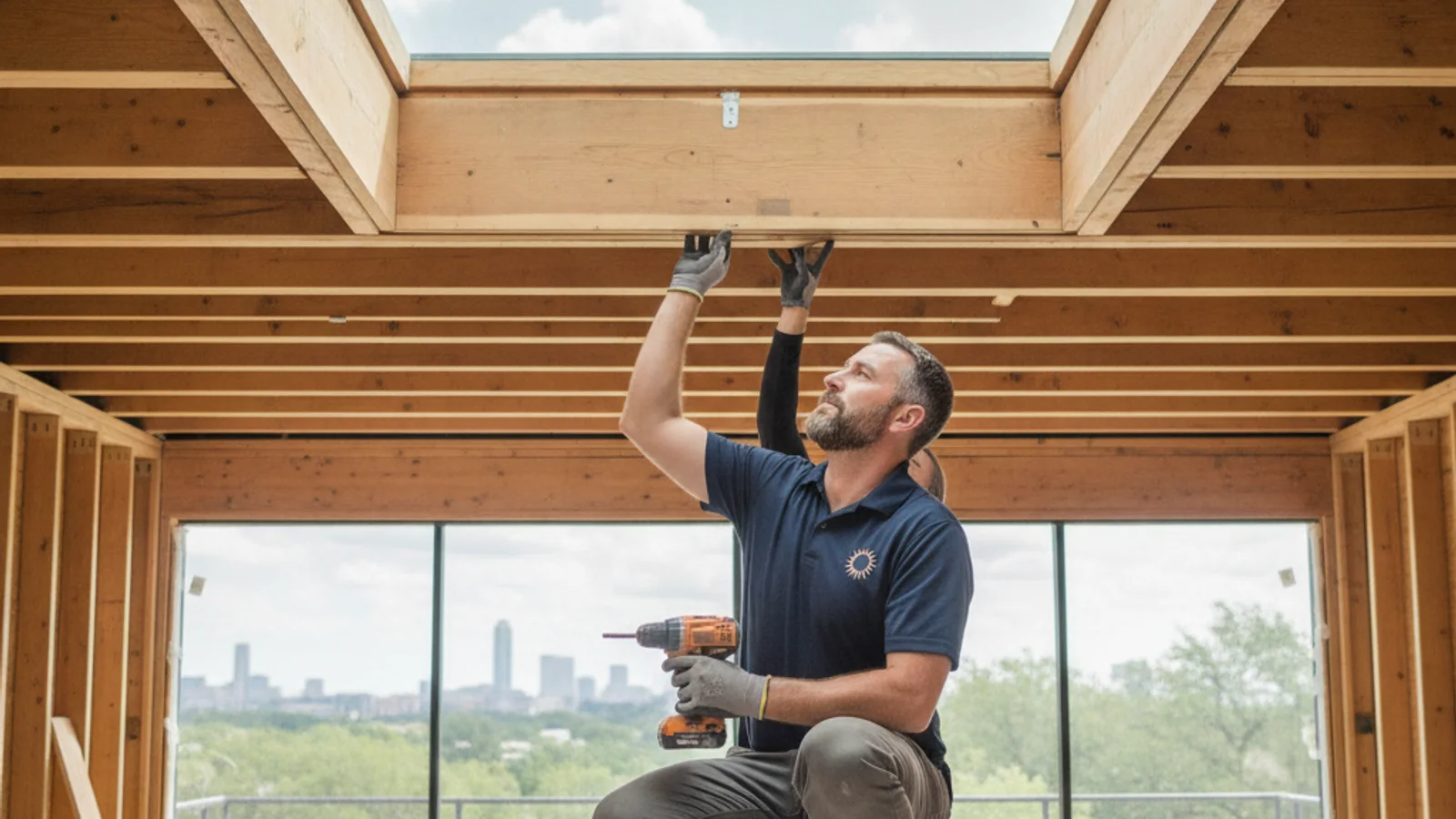
A single standard skylight on an accessible pitched roof typically installs in a day. A solar tube often takes just a few hours. What extends a project isn’t the base install itself, it’s the complications layered on top: a flat roof, a metal roof, a tricky attic, or an extra permitting step.
What actually adds time to the job
Flat-roof curb-mount work. A pitched shingle roof usually gets a deck-mount skylight in a single pass. A flat or low-slope roof needs a curb-mounted unit with cricket flashing to manage standing water, which is more framing and flashing work than a standard install.
Metal-roof flashing kits. Standing-seam metal doesn’t accept the same step-flashing method used on shingles. It needs a seam-matched flashing kit installed correctly the first time, which takes more care and usually more time than shingle flashing.
Tricky attic access. A short, straight attic run between the roof and the room below is fast work. A cramped attic, an obstructed run, or a location that requires extra framing between rafters adds hours regardless of roof type.
A historic-district review step. If your home sits in Hyde Park, Clarksville, or another local historic district, a Certificate of Appropriateness review happens before the crew ever shows up. That’s a separate clock from install day itself, and it’s worth reading through what skylights in Austin’s historic districts actually requires if that applies to your address.
Two different clocks: permitting and install day
It helps to think of a skylight project as running on two separate timelines. Permitting happens first, and it’s a paperwork and review process through Austin’s Development Services department, not something that happens the same week the crew arrives. Install day is a separate, much shorter event that happens once the permit clears. Homeowners sometimes expect the whole project to move at install-day speed from the start, and the permitting step is usually where that expectation needs adjusting.
Austin’s weather adds its own scheduling logic
An open skylight or solar tube roof penetration means install day gets planned around the forecast, not just around the crew’s calendar. Rain during an open-roof job is a real problem, so a good installer builds weather buffer into the schedule rather than pushing through regardless. Austin’s peak hail season, March through June, adds another layer: a crew doing open-roof work during that stretch is watching the forecast more closely, and scheduling around active storm risk can push a start date by a day or two here and there.
Why a realistic timeline protects the quality of the work
There’s a practical reason to care about timeline beyond scheduling convenience: a crew rushed against an unrealistic deadline is more likely to cut a corner somewhere, and flashing work is exactly the kind of detail that suffers when time pressure builds. A contractor who gives you a clear, honest timeline up front, including the buffer for weather or complications, is generally more trustworthy than one who promises a same-day turnaround on a project that clearly involves flat-roof curb-mount work or a historic-district review. Treating the timeline conversation as part of vetting a contractor, not just a scheduling detail, tends to correlate with better outcomes overall.
What happens on install day
A standard single-unit install on an accessible roof typically runs through the same sequence. The crew sets up roof access and protects the work area below, then cuts or confirms the rough opening and completes any needed framing. Flashing goes in next, matched to the roof material, followed by setting the unit itself and sealing it. Interior trim and drywall finish around the light well usually wrap up the same day for a straightforward job, though a more involved light well on a vaulted ceiling can push interior work into a second visit.
For a solar tube, the sequence is shorter: roof penetration, dome and flashing, tube run through the attic, and ceiling diffuser installation, often completed in a few hours on a straightforward attic run.
Before install day: what usually happens first
Before a crew ever shows up with equipment, there’s typically a quote visit that includes an attic inspection and a roof assessment. That visit is where the actual timeline for your specific project gets set, not a generic estimate applied to every home. The technician doing that visit is checking framing layout, attic access, roof material and condition, all of which feed directly into whether you’re looking at a standard one-day install or something that needs more planning. Getting a clear, specific timeline at that stage, rather than a rough guess, is worth asking for directly.
Coordinating around your household
For most single-unit installs, you don’t need to plan your whole day around the project, but it’s worth thinking through a few practical details ahead of time. Vehicles may need to be moved to give the crew clear access for a ladder or lift near the work area. Pets that startle at unfamiliar noise or activity outside are often better off in a closed room for the day. If the install involves interior drywall or trim work in a room you use daily, like a kitchen or living room, planning around that disruption, even for a single day, makes the process smoother on both ends.
How multi-unit projects scale
A project with multiple skylights or several solar tubes doesn’t multiply time evenly. The setup and roof-access portion of the job happens once, and each additional unit adds incremental time rather than a full extra day per unit. A three-tube kitchen project, for example, usually finishes well inside a single day on an accessible roof, while three full skylights on separate roof planes can reasonably stretch across two days depending on access and roof type.
What can push a project back before install day even arrives
Not every delay happens on install day itself. Material lead times for a specific glazing tier or a less common tube diameter can add days or weeks between ordering and the crew showing up, particularly for a specialty vented unit or a specific accessory combination rather than a standard fixed skylight. Permit review timing, which runs on Austin’s own municipal schedule rather than your installer’s, is another variable outside anyone’s direct control once the application is submitted. Building both possibilities into your expectations from the start, rather than assuming ordering and install day happen back to back, sets a more realistic picture of the full project timeline.
Does a skylight install disrupt the whole day at home?
For a single unit on an accessible roof, most of the disruption is limited to the work area directly below the opening and the roof access path outside. You don’t need to plan for the whole house being off-limits, though the room getting the skylight will have some dust and activity for the day.
What happens if it rains mid-install?
A good crew won’t leave a roof opening exposed. Work gets temporarily covered and sealed against weather, and the remaining steps resume once conditions clear. This is one reason scheduling flexibility during Austin’s hail season, March through June, matters more than it would in a drier stretch of the year.
How much longer does a flat-roof or metal-roof install take?
Both typically add time compared to a standard pitched shingle install, since curb-mount framing and seam-matched metal flashing both take more careful work than standard step flashing. The exact difference depends on the specific roof, which is something a quote visit nails down before work starts.
Planning around your own timeline
If you’re weighing a skylight or solar tube project against an upcoming season or an event at home, it’s worth getting a realistic number for your specific roof rather than assuming the fastest-case timeline applies. Bright Sky ATX connects Austin homeowners with experienced, insured local crews for skylight installation and solar tube installation alike. Call (737) 477-8898 for a free estimate.