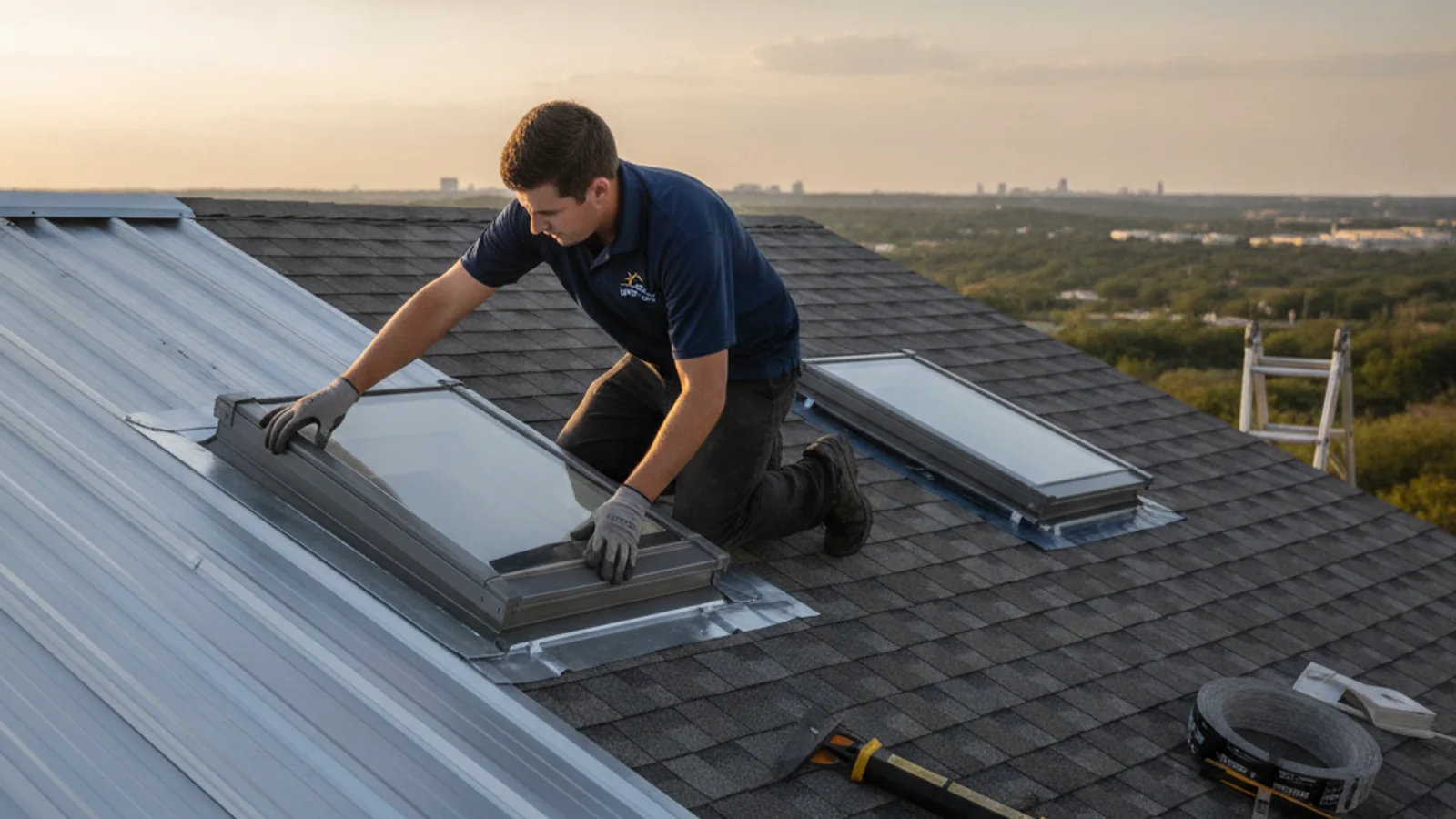
Shingle roofs use step flashing woven into the shingle courses around a skylight. Standing-seam metal roofs use a seam-integrated flashing kit that ties into the panel profile instead. These are two genuinely different methods, not two versions of the same technique, and treating them interchangeably is one of the more common causes of a skylight leak on the wrong kind of roof.
Step flashing on a shingle roof, explained
Step flashing is a series of small, overlapping metal pieces, each one integrated with an individual shingle course as the roofer works up the slope around the skylight curb. Each piece overlaps the one below it and tucks under the shingle above it, so water running down the roof sheds over each layer in sequence rather than finding a gap to get behind. Done correctly, this creates a continuous, layered barrier around the skylight opening that moves with the roof rather than fighting it.
Seam-integrated flashing on standing-seam metal
Standing-seam metal roofing doesn’t have overlapping courses the way shingles do, so step flashing simply doesn’t apply the same way. Instead, a metal-roof skylight uses a flashing kit designed to match that specific panel’s seam spacing and profile, installed in a way that avoids penetrating the panel face wherever possible. The seams themselves, rather than layered shingle courses, are what the flashing integrates with to keep water moving off the roof and away from the skylight opening.
Why metal-roof flashing costs more
A shingle roof’s step flashing uses standardized components that fit a wide range of common shingle profiles, which keeps both material cost and labor relatively predictable. A metal roof’s flashing kit has to match a specific panel’s seam spacing and profile, and there are more standing-seam panel variations in circulation than there are standard shingle profiles. That means fewer one-size-fits-all kits, more measuring and matching work, and a job that generally requires more specialized experience to get right the first time. All of that adds up to a real cost difference between the two, not just a marketing distinction.
What goes wrong most often on each
On a shingle roof, the most common failure is step flashing that wasn’t woven correctly into the courses during the original install, whether from rushed work or unfamiliarity with the method. On a standing-seam metal roof, the most common failure is a mismatched seam kit, either the wrong profile for that specific panel or an installer improvising a shingle-style approach on a roof that doesn’t support it. Both failure modes trace back to the same root cause: a flashing method that wasn’t correctly matched to the specific roof it was installed on.
Why this matters more in Austin now than a decade ago
Standing-seam metal roofing has grown sharply across the Austin metro over the past five years, up more than 40 percent, largely driven by its hail resistance and energy efficiency compared to shingle roofing. That shift means a growing share of Austin homes now need the metal-specific flashing approach rather than the shingle method most installers have historically defaulted to, and it’s part of why confirming an installer’s specific metal-roof experience matters more today than it used to.
Solar tubes face the same flashing distinction
Everything here about full skylight flashing applies equally to solar tube installations, just at a smaller physical scale. A solar tube’s dome and collar still need to integrate correctly with whatever roof material surrounds it, and a tube installed on a standing-seam metal roof needs the same seam-matched flashing approach a full skylight would, not a smaller version of a shingle-style method. Because a solar tube’s roof penetration is smaller, it can be tempting to assume the flashing detail matters less. It doesn’t. A poorly matched flashing kit on a small penetration leaks just as reliably as one on a larger opening.
How the two methods actually shed water differently
The underlying goal of both flashing systems is the same: keep water moving down and off the roof rather than letting it pool or find a gap at the skylight opening. Step flashing achieves this through overlap and gravity, with each piece layered so water sheds from one to the next in sequence as it flows down the shingle field. Seam-integrated metal flashing achieves the same goal by working with the panel’s existing water-shedding geometry, since a standing-seam roof is already engineered to move water along its ribs and down the slope without penetrations. A flashing kit that respects that existing geometry, rather than fighting it with an unrelated method, is what keeps the system working the way the roof was designed to work in the first place.
Retrofitting an old flashing job during a re-roof
A re-roof is a natural moment to correct a flashing method that was never right for the roof to begin with, particularly when a home is switching from shingle to standing-seam metal as part of the same project. A skylight that was originally step-flashed on a shingle roof needs an entirely different flashing approach once the roof material changes, not a reused version of the old kit. Anyone planning a shingle-to-metal re-roof with an existing skylight or solar tube in place should treat the flashing as something that gets fully redone during that transition, not something that can be salvaged from the old install.
What to confirm before a metal-roof project starts
Before a skylight or solar tube project begins on a standing-seam metal roof, it’s worth asking the installer directly how many similar metal-roof jobs they’ve completed, whether they’re using a manufacturer-specific flashing kit matched to your exact panel profile, and how they handle a seam that doesn’t line up perfectly with the planned opening location. A skylight installation crew with real standing-seam experience will have straightforward answers to all three; a generalist crew doing their first metal-roof flashing job on your house often won’t.
Signs your existing flashing might already be the wrong method
If you already have a skylight or solar tube on a metal roof and aren’t sure whether it was flashed correctly for that roof type in the first place, a few signs are worth watching for. Staining that follows the edge of the skylight in a consistent pattern, rather than appearing randomly, often points to a flashing method that isn’t sealing correctly along one particular seam or edge. A repair that keeps recurring in roughly the same spot after each fix is another sign the underlying method, not just a single failed component, is the actual problem. If either of those sounds familiar, it’s worth having the flashing method itself evaluated rather than treating each new leak as an isolated incident.
Can shingle-style flashing be used on a metal roof?
No, not reliably. Step flashing is built around overlapping shingle courses, which don’t exist on a standing-seam metal roof. Attempting a shingle-style approach on metal creates a real leak risk, since the flashing method isn’t designed to integrate with the panel seams the way it needs to.
Does metal-roof flashing void the roof’s warranty?
It can, if the flashing work isn’t done to the metal roof manufacturer’s specifications or damages the panel finish during installation. This is a real reason to confirm your installer’s specific experience with your panel type before work starts, and to ask how their approach interacts with your existing roof warranty.
Why does a metal-roof skylight install often cost more?
Metal-roof flashing requires a kit matched to that specific panel’s seam profile rather than a standardized shingle-compatible component, along with more specialized labor to install it correctly. Both factors add real cost compared to a standard shingle-roof flashing job.
Getting the flashing method matched to your roof
Whether your roof is shingle or standing-seam metal, the flashing method has to match the material, not the other way around. Bright Sky ATX connects Austin homeowners with experienced, insured local crews for skylight repair and skylight installation on both roof types. Call (737) 477-8898 for a free estimate.