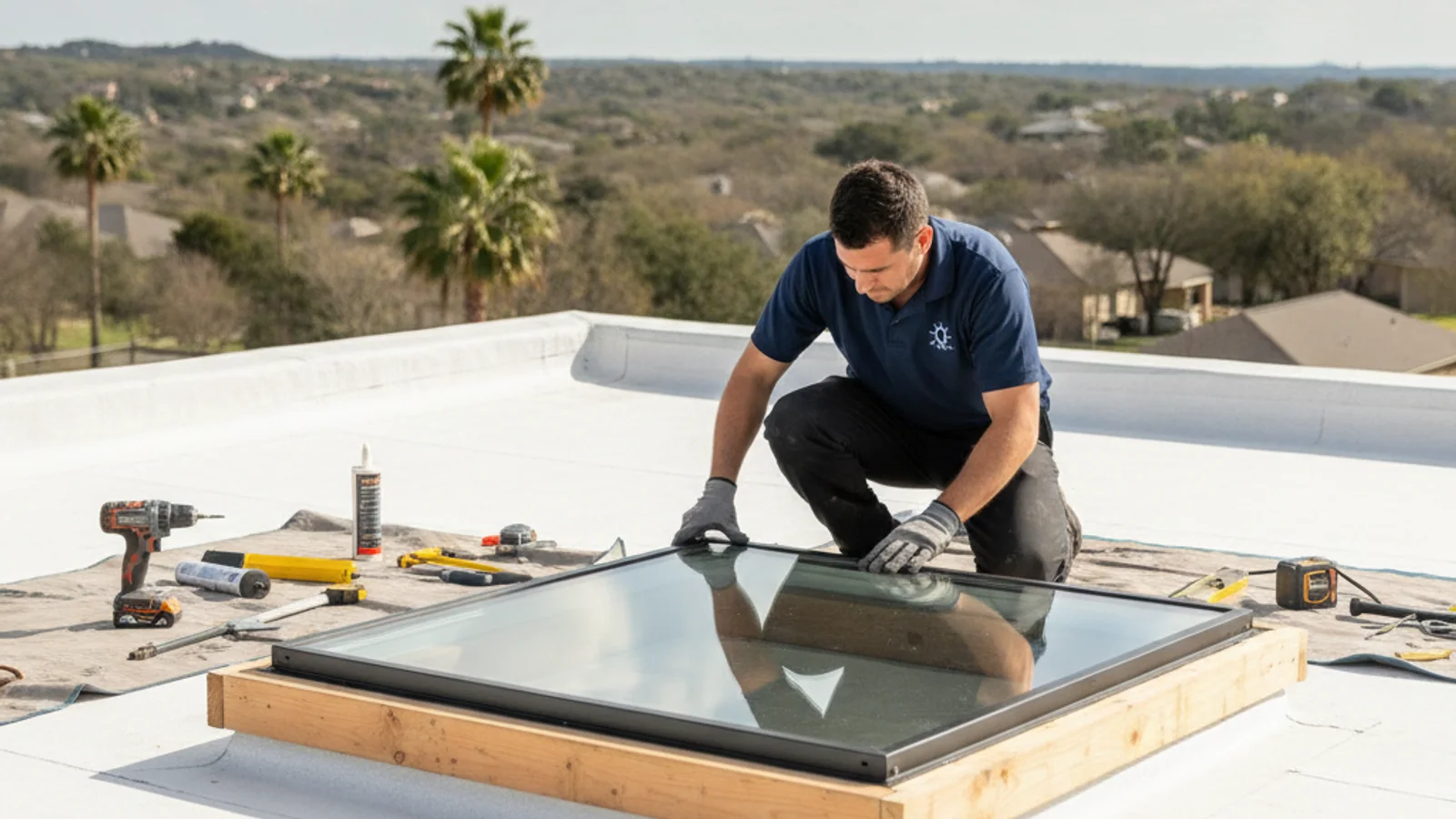
Flat and low-slope roofs need a curb-mounted skylight, a raised frame with dedicated drainage built around it, not the flush-mount method used on a pitched shingle roof. Trying to install a standard deck-mount unit on a flat roof is a leak waiting to happen, and it’s one of the more common mistakes we see when a general contractor unfamiliar with flat-roof work takes on a skylight project without adjusting the method.
Why standing water is the real design problem
A pitched roof sheds water on its own, by gravity, before it ever gets near a skylight opening. A flat or low-slope roof doesn’t have that advantage, so water can sit and pool right at a roof penetration if nothing is done to route it away. Even a roof with a slight slope, common on what people call a “flat” roof since true dead-flat is rare, can still hold standing water long enough after a storm for it to find any weak point in a flush-mounted fixture. A curb mount raises the skylight above the roof surface, and cricket flashing, a small sloped diverter built into the roofing material behind the curb, redirects water around the opening instead of letting it pool against it.
Where this comes up most in Austin
Low-slope mid-century roofs are common in neighborhoods like Barton Hills and Zilker, where a lot of the original housing stock was built with flat or shallow rooflines as part of the era’s architectural style. It also comes up constantly on flat commercial roofs across the metro, where warehouses, retail centers, and office buildings sit under the same drainage challenge at a larger scale, often with dozens of roof penetrations across a single building that all need the same careful drainage planning applied consistently.
Curb mount vs. deck mount, in more depth
Deck mount sits directly on the roof deck and is the standard approach on a typical pitched shingle roof. Curb mount is required on flat and low-slope roofs specifically because of the drainage issue above. We cover the full side-by-side comparison, including cost and leak-risk differences, in a separate post, but the short version relevant here is that a flat roof effectively removes deck mount as an option regardless of cost preference, since the drainage physics don’t work without a raised curb.
Material considerations
Flat roofs aren’t all the same material, and each one flashes differently around a curb:
- Built-up roofing (BUR) uses layered asphalt and gravel or a cap sheet, and flashing has to tie into those layers correctly to maintain the roof’s overall waterproofing system.
- TPO is a single-ply membrane that needs heat-welded or adhered flashing detail specific to that material, and using the wrong bonding method compromises the seal.
- Modified bitumen is torched or adhered in sheets, with its own flashing approach that differs from both BUR and TPO.
Getting the wrong flashing method for the roof material is one of the more common causes of a flat-roof skylight leak, and it’s a workmanship issue, not a design flaw in curb mounting itself. An installer experienced across all three materials will know to ask what your roof is made of before quoting the flashing approach.
Solar tubes on a flat roof
The same curb-mount logic applies to a solar tube on a flat roof, just at a smaller and generally cheaper scale than a full skylight. The dome still needs a raised, properly flashed base rather than sitting flush against a low-slope surface, and the same material-specific flashing considerations above apply just as much to a tube’s smaller footprint as they do to a full skylight curb.
What tends to go wrong on a poorly-installed flat-roof skylight
Undersized cricket flashing that doesn’t fully divert water, a curb height that’s too low for the amount of standing water the roof sees, or flashing that doesn’t match the specific roofing material are the most common failure points. These problems don’t always show up right away; a poorly built curb can hold up fine through light rain and only reveal its weakness during a heavier storm when more water sits against it for longer. Ask a contractor directly how they’re handling drainage and which flashing method they use for your specific roof material before work starts, and ask to see examples of similar flat-roof work they’ve completed.
Roof access and staging for the crew
Flat roofs are generally easier and safer for a crew to work on than a steep pitched roof, since there’s no risk of sliding and materials can be staged directly on the roof surface rather than hauled up and down repeatedly. That can translate into a somewhat more efficient install day compared to the same scope of work on a steep-slope roof, though the added flashing and curb-building steps specific to flat-roof work tend to offset some of that efficiency gain. Ask your contractor how they plan to stage materials and protect the existing roofing membrane during the work, particularly on a membrane roof like TPO where foot traffic and equipment can cause its own damage if not managed carefully.
Insulation and condensation on a flat-roof unit
A curb-mounted skylight has more surface area exposed between the conditioned space below and the outside air than a flush deck-mount unit does, since the curb itself is essentially an insulated box connecting the two. A well-built curb includes insulation inside its walls to reduce that thermal bridge, which matters both for energy performance and for reducing the chance of condensation forming on the curb’s interior surface during Austin’s humid, temperature-swinging seasons. This is a detail worth asking about specifically, since an uninsulated curb is a common shortcut on lower-quality installs that shows up later as an energy or moisture complaint rather than an immediate problem.
How curb height gets decided
Curb height isn’t a fixed, one-size number. It’s set based on how much standing water the specific roof area tends to hold after a heavy rain, which depends on the roof’s actual slope, its drainage layout, and where the skylight sits relative to roof drains or scuppers. A low point on the roof where water naturally collects needs a taller curb than a spot closer to a drain where water moves off more quickly. This is one of the details a contractor should be assessing on-site rather than applying a standard height across every job regardless of the specific roof’s drainage pattern.
What a proper quote for flat-roof work should include
A trustworthy quote for a flat-roof skylight or solar tube should specify the curb height being used, the flashing material and method matched to your specific roof type, and whether cricket flashing is included where standing water is a concern. If a quote doesn’t mention any of these details and simply lists “skylight installation” as a single line item, it’s worth asking directly how they’re planning to handle drainage on your specific roof. A contractor experienced with flat-roof work will typically bring these details up unprompted, since they know it’s the part of the job most likely to go wrong if skipped.
Why re-roofing is a natural moment to address this
If a flat or low-slope roof is coming up for replacement or a major repair, that’s often the most cost-effective time to add or upgrade a skylight, since the curb and flashing work can be integrated into the broader roofing project rather than done as a separate later penetration into an already-finished roof. Homeowners planning a flat-roof replacement project are worth encouraging to raise the skylight question with their roofer early, rather than after the new roof is already complete.
Can a flat roof handle a skylight?
Yes, with a curb-mounted unit and proper drainage planning. A flush deck-mount unit built for a pitched roof is not the right approach on a flat or low-slope surface, and using one there is a design mismatch regardless of installer skill.
Do flat roof skylights leak more than pitched-roof ones?
Not inherently, but they’re less forgiving of installation mistakes since gravity isn’t doing as much of the drainage work on its own. A properly built curb and cricket flashing hold up well, often for as long as a comparable pitched-roof installation, but the margin for error during installation is narrower.
What’s a cricket, and why does it matter?
A cricket is a small sloped diverter built into the roofing behind the curb, directing water around the skylight opening instead of letting it collect against it. It’s a standard part of a correctly installed flat-roof skylight and one of the details worth confirming is included in any quote for flat-roof work.
If you’ve got a flat or low-slope roof and you’re weighing a skylight or solar tube, the drainage plan matters as much as the fixture itself. Bright Sky ATX connects Austin homeowners and businesses with experienced, insured local crews for flat roof skylights, skylight installation, and solar tube installation. Call (737) 477-8898 for a free estimate.