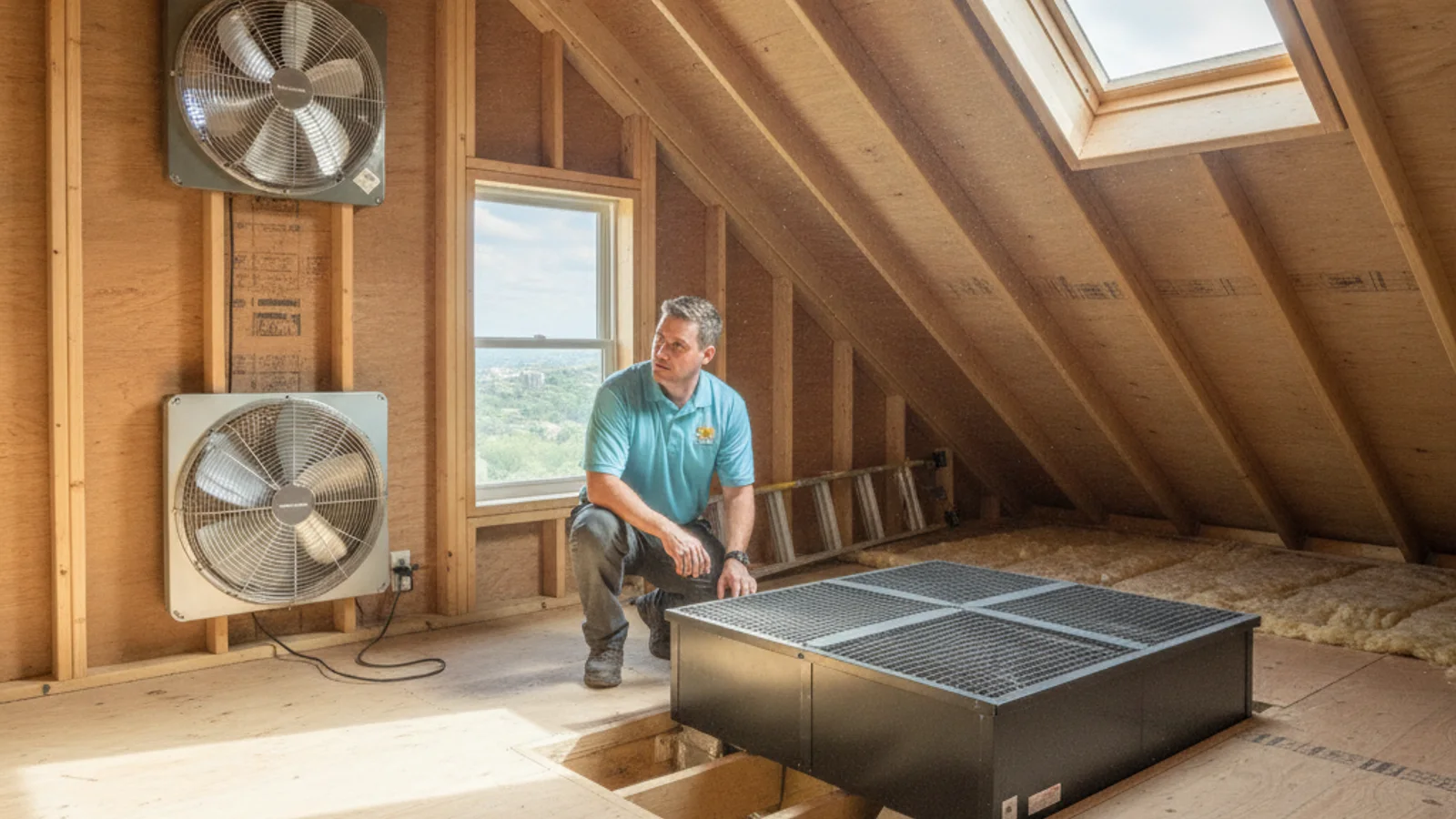
An attic fan cools the attic only. A whole house fan pulls cooler outside air through the entire living space at night. They do different jobs, and a lot of Austin homes end up better off with both rather than picking just one.
It’s a common point of confusion, partly because both products involve a fan and a roof or ceiling, and partly because both get pitched as ways to cut cooling costs. But they’re solving two separate problems: one keeps a hot attic from acting like a heat radiator over your living space, and the other uses cool outdoor air to flush heat out of the rooms you’re actually in. Understanding which problem you actually have makes the decision a lot easier than comparing the products head-to-head as if they were competing for the same job.
What each one actually does
An attic fan sits on the roof or gable and exhausts hot attic air to the outside, which keeps that space from turning into an oven that radiates heat down into the rooms below. On a typical Austin summer afternoon, an unvented attic can climb well past the outdoor temperature, and all that heat sits directly above your ceiling insulation, working its way down into the house all day. An attic fan interrupts that by continuously pulling the hottest air out and replacing it with air drawn in through soffit or gable vents.
A whole house fan sits in a central hallway ceiling and, when you open a few windows and switch it on, pulls in cooler evening or nighttime air and pushes the day’s built-up heat out through the attic and roof vents. It’s a much larger volume of air movement than an attic fan handles, and it’s meant to run for a defined window of time, typically evening through early morning, rather than continuously. One manages the attic as its own zone. The other treats the whole house as one system for a few hours a day.
When an attic fan is the right call
If your AC seems to work harder than it should on a hot afternoon and the attic above the ceiling is noticeably hotter than the rest of the house, an attic fan addresses that directly. It’s most effective once insulation and air sealing between the living space and the attic are already handled, since a fan working against gaps and thin insulation is fighting a losing battle; you’d essentially be paying to move air through a space that’s still transferring heat straight through into the ceiling below regardless of how well ventilated it is. If you haven’t had your attic insulation assessed recently, that’s worth doing alongside, or even before, an attic fan installation.
When a whole house fan is the right call
Austin’s evenings cool off more than the daytime highs suggest for most of the year, and a whole house fan is built to take advantage of exactly that swing. It works best in a home with the ceiling access and structural layout to support central mounting, which isn’t automatic in every older house. Homes with original wiring or tight attic clearance sometimes need extra assessment before installation, which we cover in more depth for older Austin homes in a separate post focused specifically on that scenario. A whole house fan also depends on you actually opening windows to let cool air in, which means it fits a household routine where someone’s around to open up in the evening and close up again before the day heats up.
Cost and install complexity, compared honestly
A whole house fan installation tends to involve more electrical and structural planning, since it’s a larger unit mounted into a central ceiling location with its own switch, and it needs enough attic volume around it to exhaust into without restriction. An attic fan install is usually more contained: roof penetration, mounting, and either a solar panel connection or a wired power source. Exact pricing depends on your roof type and attic access, and it’s worth getting a same-visit quote for both if you’re weighing them against each other, since a single site visit can usually confirm whether your attic layout supports either option without much added cost.
Electric bill impact, honestly
Neither one replaces air conditioning on a 99°F August afternoon, and no reputable installer should tell you otherwise. What both do is reduce how hard the AC has to work during shoulder-season stretches and overnight hours, by keeping the attic from acting as a heat radiator and by using free outside air when it’s actually cooler outdoors than in. That’s a real, if modest, reduction in AC runtime rather than a dramatic bill cut, and the size of that reduction depends on your home’s insulation, duct sealing, and how consistently you use either fan. Treat either one as a complement to a well-sealed, well-insulated home rather than a fix for a home that has bigger air-sealing problems to begin with.
Can a home have both, and does it make sense?
Yes, and in a lot of cases it makes more sense than picking one. The attic fan keeps the attic itself from overheating year-round, while the whole house fan gives you a way to cool the living space directly on the many Austin evenings when it drops into the 70s. They’re not solving the same problem, so running both isn’t redundant, and in practice a lot of homeowners end up adding the second one after living with just the first for a season and noticing what it doesn’t cover.
What installation actually looks like for each
For an attic fan, the process starts with confirming where on the roof or gable the unit will sit, based on where it can pull air most effectively and where the roof structure supports the mounting. From there it’s a roof or wall penetration, mounting the housing, sealing around it, and running power, either to a solar panel connected nearby or to a wired circuit if you’re going hardwired. Most attic fan installs are completed in a single visit.
A whole house fan install involves more coordination. The installer needs to identify a central hallway location with enough clearance above the ceiling for the fan housing and enough open attic volume around it for air to actually exhaust without restriction. That often means checking rafter spacing and insulation depth in that specific spot before cutting the ceiling opening. Electrical work to bring power to a switch, and sometimes a dedicated circuit, adds another step that an attic fan install typically doesn’t need in the same way.
Noise and comfort considerations
Attic fans run continuously or on a thermostat trigger, and because they’re up in the attic, most homeowners don’t hear them from inside the living space at all. A whole house fan is a different experience: it moves a large volume of air and sits much closer to the rooms you’re in, so there’s an audible whoosh when it’s running, along with a noticeable draft from whichever windows are open. Some homeowners like that as a sign it’s working; others find it more noticeable than expected the first few times, especially at night with bedroom doors open. It’s worth knowing that upfront rather than being surprised by it after installation.
Does an attic fan work with a whole house fan?
Yes. They operate independently and address different parts of the house, so having both installed doesn’t create a conflict. In fact, a well-ventilated attic from an attic fan can make a whole house fan’s job easier, since it isn’t pushing exhaust air into an attic that’s already saturated with heat.
Which uses less electricity?
A solar attic fan draws no household electricity once installed. A whole house fan and a hardwired attic fan both use some power, though a whole house fan typically only runs for a few hours a day rather than continuously, which keeps its overall draw modest compared to running it around the clock.
Do either work during an Austin summer heat wave?
They help reduce AC strain during a heat wave, but neither is a substitute for air conditioning on the hottest afternoons. A whole house fan is most useful once outdoor temperatures drop back down in the evening; during a stretch where nighttime lows barely dip, its benefit shrinks accordingly, which is worth knowing before expecting it to carry the same load every night of summer.
If you’re not sure which one fits your attic and your home’s layout, that’s worth a real assessment rather than a guess. Bright Sky ATX connects Austin homeowners with experienced, insured local crews for solar attic fan installation and whole house fan installation. Call (737) 477-8898 for a free estimate.