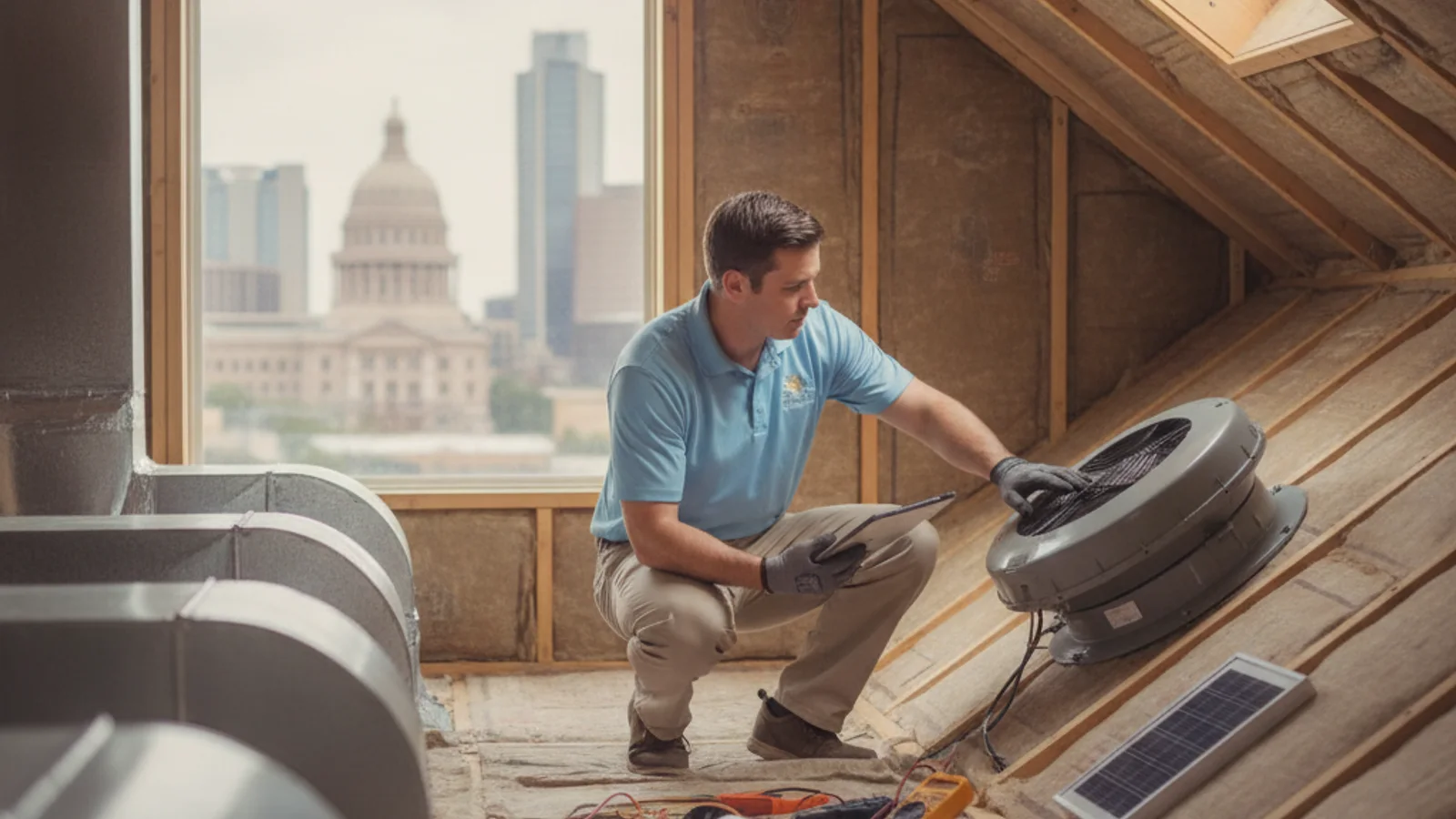
A solar attic fan that’s stopped spinning is usually a motor or panel problem, and either one is often cheaper to fix or swap than replacing the whole unit. The exception is when the flashing or roof seal around the housing has also failed. That’s a different repair with a different price tag.
Why the fan stopped spinning
A dead or shaded panel. Solar attic fans run directly off the panel, with no battery backup on most residential units. If the panel is caked in dust, shaded by a growing tree limb, or wired loose, the fan gets no power and just sits there.
A worn motor bearing. Years of Austin summer heat take a toll on a motor’s internal bearings. A fan nearing the end of its service life often starts slower than it used to, or runs with a faint grinding sound before it stops altogether.
A loose or corroded wiring connection. The link between the panel and the motor is a simple two-wire circuit, but Austin’s swing between summer heat and winter cold snaps can work a connector loose over several seasons.
Panel problem or motor problem: a quick homeowner check
You can narrow this down from the ground before calling anyone. On a clear, sunny day, look up at the fan blade. If it’s spinning normally in full sun, the panel and wiring are fine and the issue is probably somewhere else, like the thermostat setting on a hybrid unit. If it’s not spinning at all in direct midday sun, the panel, the wiring connection, or the motor itself is the likely culprit. A fan that spins weakly or intermittently often points to a motor nearing failure rather than a power-supply issue.
None of that tells you for certain which part failed, and getting on a roof to test voltage at the panel isn’t a job to do yourself. But it narrows the conversation before a technician shows up, and it helps you describe the symptom accurately.
When it’s not the fan at all
Sometimes what looks like a fan problem is actually a roof problem around the fan housing. The same flashing logic that governs a leaking skylight applies here: the metal collar sealing the fan base to the roof deck can fail from age, thermal cycling, or a bad original install, and that shows up as water staining near the unit rather than as the fan simply not spinning. If you’re seeing moisture in the attic near the fan base along with the mechanical issue, that’s a roof-seal problem layered on top of whatever’s wrong with the motor or panel, and it needs its own fix. A skylight repair technician who handles roof penetrations can diagnose flashing failure around a fan housing the same way they’d diagnose it around a skylight curb.
Repair vs. swap: the honest version
There’s no fixed rule that says repair is always cheaper, but in practice a straightforward panel swap or a wiring fix tends to cost less than replacing the entire fan assembly, mount and all. A failed motor is a closer call. Some units have a motor that can be swapped independently of the panel and housing; others are sold as a sealed assembly where the whole unit gets replaced once the motor goes. Which case you’re in depends on the brand and model installed, which is exactly the kind of detail worth confirming before assuming either direction.
When age settles the question
A solar attic fan nearing the end of its typical service life is often better replaced outright than repaired a second or third time. If a fan has already had one motor or panel issue and a different problem shows up within a year or two, that’s usually a sign the whole unit is wearing out together, not that you got unlucky twice. At that point, a straightforward replacement, matched to the same roof penetration and mounting hardware, is usually the more sensible move than chasing one component failure after another.
What a repair visit actually looks like
A technician troubleshooting a stalled solar attic fan usually starts at the panel, checking voltage output in direct sun and confirming the panel isn’t shaded by a tree limb that’s grown in since the fan was installed. From there, the wiring run between panel and motor gets checked for loose connectors or corrosion, particularly at any junction point exposed to attic heat cycling. If power is reaching the motor and it still isn’t turning, or is turning weakly with a grinding or clicking sound, that points toward a worn bearing or a failing motor winding. Each of those is a different fix with a different cost, which is exactly why a proper diagnosis matters more than guessing and replacing parts one at a time.
Simple upkeep that prevents a repair call later
A lot of solar attic fan service calls trace back to something that could have been caught earlier with basic upkeep. Keeping the panel clear of dust, leaves, and pollen buildup a couple of times a year helps it keep producing full power, especially during Austin’s oak pollen season each spring when a fine yellow film settles on anything left outdoors. Trimming back tree growth that’s started to shade the panel during peak sun hours is another simple check, since even partial shading meaningfully cuts a solar panel’s output. None of this replaces a proper inspection when something’s actually wrong, but it reduces how often something goes wrong in the first place.
How the roof penetration itself holds up over time
Beyond the fan’s own mechanical parts, the roof penetration where the fan housing meets the shingles or metal panel is worth thinking about as its own long-term component. Sealant and flashing around any roof-mounted fixture age with sun exposure and thermal cycling the same way skylight flashing does, and a fan housing that’s been in place for many years is due for a visual check of the seal around its base even if the fan itself is running fine. Catching a degrading seal before it starts leaking is a lot less disruptive than discovering it after water has already reached the attic insulation or ceiling below.
What to have checked before you decide
A technician assessing a stalled fan should confirm three things: whether the panel is producing power in direct sun, whether the wiring connection between panel and motor is intact, and whether the flashing around the housing is still sealing correctly. That third check matters even if the fan itself turns out fine, because a fan that’s spinning normally over a leaking seal is still a roof problem waiting to surface. Getting all three checked in one visit avoids a second trip for something that could have been caught the first time.
Why did my solar attic fan stop spinning?
The most common causes are a shaded or dirty panel, a loose wiring connection between the panel and motor, or a worn motor bearing reaching the end of its service life. Checking whether the fan spins in direct midday sun is a quick way to narrow down which category you’re likely dealing with before a technician takes a closer look.
Can the motor be replaced without replacing the panel?
On some models, yes. Others are built as a sealed assembly where a failed motor means replacing the full unit, panel included. Which situation applies depends on the specific brand and model installed, so it’s worth confirming rather than assuming either way.
Is a stalled attic fan a sign of a bigger roof problem?
Not always, but it’s worth ruling out. A stalled fan is often just a mechanical or electrical issue with the fan itself. If you’re also noticing moisture or staining near the fan base in the attic, that points to a separate flashing failure around the roof penetration, which needs its own inspection regardless of what’s wrong with the fan.
Getting it looked at
Austin attics commonly reach 120 to 150 degrees at peak summer, which is exactly why a fan that quietly stops working gets noticed fast here. If yours has stalled, or you’re not sure whether it’s the panel, the motor, or the roof seal around it, that’s worth a proper look before another hot stretch rolls through. Bright Sky ATX connects Austin homeowners with experienced, insured local crews for solar attic fan installation and repair alike. Call (737) 477-8898 for a free estimate.